IF26 Heat Auction: What European Industry Need to Know
Overview
- The IF26 Heat Auction offers up to €1 billion in EU funding for industrial heat decarbonisation projects across EEA member states
- Solar thermal qualifies as a direct-renewable heat technology; the minimum eligible temperature threshold has been lowered to 80°C for projects over 10 MW, widening the pool of qualifying industrial processes
- A bid bonus is available for technologies that reduce electricity grid demand during peak hours, a criterion that solar thermal meets by design
- Applications are expected to open December 2026, with a submission deadline of February 2027, verify opening dates and deadlines against the published call documents before acting
Estimated read time: 6-7minutes
What is the IF26 Heat Auction and who is eligible?
The IF26 Heat Auction is a competitive EU grant scheme managed by the European Commission and financed through EU ETS revenues. It offers up to €1 billion to support industrial heat decarbonisation projects across EEA member states. Industrial operators and manufacturers with projects that cut CO2 emissions from process heat are eligible to apply.
Up to €1 billion is available for industrial heat decarbonisation in Europe, and the application window for the IF26 Heat Auction is shorter than the preparation work it requires. Applications are expected to open in December 2026, with a submission deadline of February 2027. For industrial operators considering solar thermal as a route to cutting process heat emissions and long-term energy costs, the time to begin feasibility assessments is now.
The IF26 call is the second iteration of the European Commission's innovation-funded heat auction, building on the IF25 pilot with improved terms, a lower minimum temperature threshold, and a revised bid mechanism. It is part of the EU Innovation Fund, which finances projects that advance low-carbon technologies across EEA member states and is financed directly through revenues from the EU Emissions Trading System.
The Challenge: Capital Costs, Application Complexity, and a Tightening Regulatory Horizon
The financial case for industrial heat decarbonisation is clear in the long run. Solar thermal and other direct-renewable heat technologies carry higher upfront capital costs than gas-fired boilers, but deliver lower and more predictable lifetime operating costs once installed. The gap between those two positions, upfront capital versus long-term savings, is precisely the space that IF26 funding is designed to close.
The regulatory pressure to close that gap is also intensifying. EU ETS2 extends carbon pricing to commercial and industrial heat from January 2027, embedding an escalating carbon cost into the price of natural gas consumed at any site not already transitioning away from fossil fuels. For manufacturers across the EEA, heat is no longer just an operational input. It is a carbon liability with a measurable and growing cost attached to it. For more information on EST2 please visit our blog here.
The IF25 pilot round demonstrated a third challenge: preparation. Of the 85 bids submitted to IF25, 65 projects were funded across 10 EEA member states, but the total budget requested reached only €397 million against a €1 billion pot. According to the European Commission, application complexity and short preparation windows were the primary reasons participation fell short, not a lack of eligible projects or demand for the funding. IF26 represents a substantial volume of accessible, under subscribed capacity, and the operators best positioned to access it will be those who begin preparing well before the December 2026 opening.
Why Solar Thermal Qualifies Under the IF26 Heat Auction
IF26 recognises two principal technology pathways for industrial heat decarbonisation: direct-renewable heat and electrification. Solar thermal, including evacuated tube technologies such as VirtuHOT and VirtuMAX, sits within the direct-renewable heat category and can be deployed in two configurations that are relevant to IF26-eligible industrial projects.
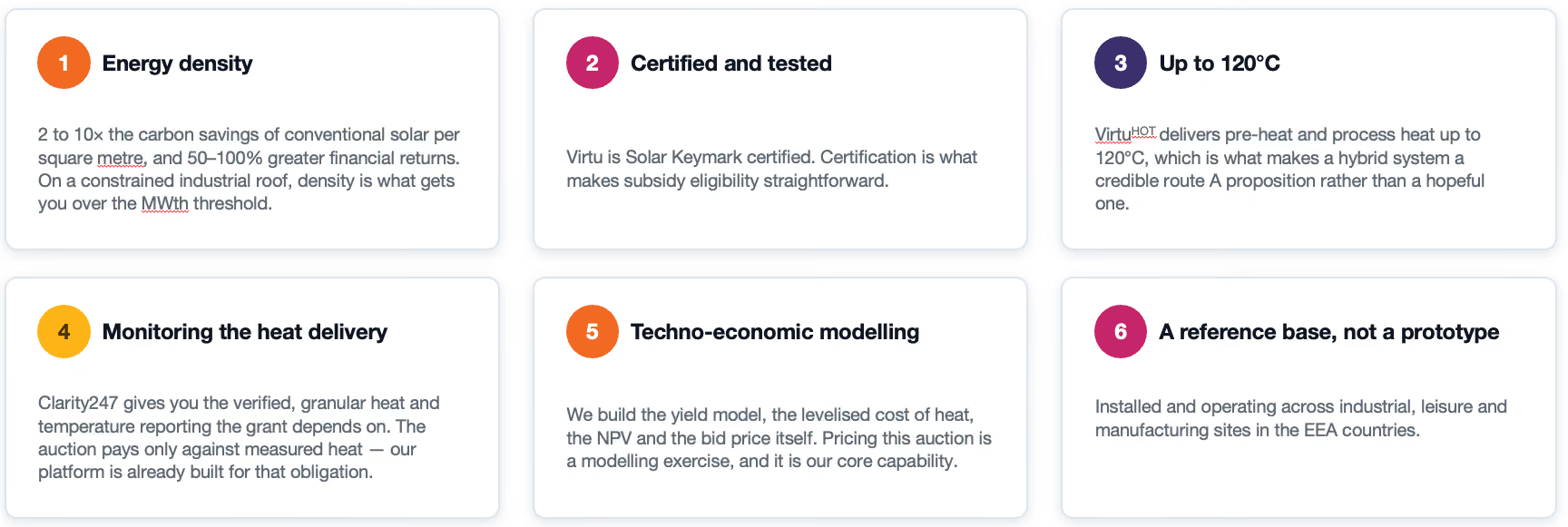
The first is as a standalone direct heat source, delivering process heat in the 80°C to 120°C range to applications such as pasteurisation, CIP, pre-heating, and washing applications across food and beverage, dairy, chemicals, textiles, and pharmaceuticals.
The second is as a heat input for industrial heat pumps in a cascade configuration: solar thermal raises the inlet temperature to the heat pump, which can then produce steam up to 180°C; this approach can also be paired with on-site PV for power generation and integrated waste heat recovery, creating a multi-technology approach that maximises total decarbonisation impact and strengthens the €/tonne CO2 abated figure that determines bid allocation.
Both configurations qualify under the IF26 direct-renewable heat classification, and the classification itself carries specific advantages within the bid structure.
The minimum temperature threshold has been lowered. For large projects above 10 MW, the minimum eligible delivery temperature has been reduced to 80°C under IF26. This is a meaningful change. It brings cleaning-in-place (CIP) circuits, pasteurisation, pre-heating, and washing operations directly into scope for manufacturers in food and beverage, dairy, chemicals, textiles, and pharmaceuticals that might previously have fallen outside the eligible range. Find out more about solar thermal operating tempratures here.
The bid mechanism now rewards CO2 abatement directly. The IF25 subsidy structure, based on €/MWh, has been replaced with a bid mechanism based on €/tonne of CO2 abated. This change favours technologies with strong CO2 displacement per unit of heat delivered, and it makes the financial modelling of a bid more directly linked to the emissions performance of the system.
A bid bonus rewards technologies that reduce grid pressure. Direct-renewable heat technologies generate heat without electricity as an intermediate step, which means no additional grid demand is created at any point in the generation process. A solar thermal system delivering 3,000 MWh of process heat per year contributes nothing to peak electricity load. This structural characteristic is explicitly rewarded under IF26's bid bonus of up to 25% of the bid price, making solar thermal more competitive at the bid level compared with electrification technologies that draw from the grid during operating hours.
VirtuHOT is TÜV Rheinland certified and has been deployed across more than 100 projects worldwide, covering applications from domestic hot water and pool heating through to brewery CIP, dairy pasteurisation, and pharmaceutical process pre-heat. Its operating range of up to 120°C covers the full scope of IF26-eligible low and medium temperature industrial processes. VirtuMAX extends the same technology to utility and district-scale deployments. For more information on both Virtu collectors, click here.
For sites with limited rooftop space,VirtuHOT's high energy density means more heat delivered per square metre of available area, which directly strengthens the €/tonne CO2 abated calculation at the point where that metric determines funding allocation.
What IF25 Delivered and What It Tells Us About IF26
The IF25 pilot round is the most direct reference point for understanding what IF26 can achieve. The European Commission funded65 projects across 10 EEA member states, awarding approximately €397 million in total. The projected impact of those projects covers an estimated 6.6 million tonnes of CO2 avoided over ten years, alongside production of approximately 16.3 TWh of decarbonised heat in the first five years of operation.
Those outcomes were achieved with only 85 bids submitted against a €1 billion budget. The practical implication is significant. Strong project outcomes, meaningful funding available, and a participation level that left the majority of the budget unallocated. The barrier to access in IF25 was not competition for scarce resources. It was preparation capacity.
IF26 builds on that foundation with improved terms, a lower temperature threshold, a simplified bid structure, and a full €1billion budget confirmed at the 2026 Cleantech Conference. For industrial operators with qualifying process heat demand, the question is not whether funding is available. It is whether the preparatory work begins early enough to make the February 2027 deadline.
Preparing for IF26: A Readiness Checklist
Based on the published draft IF26 Terms andConditions from the European Commission's DG Climate Action, and analysis published by innovation funding consultancy PNO in July 2026, applicants will need to demonstrate readiness across several areas before the application window opens. Preparation is not optional, it is the primary variable that determined which operators succeeded in IF25.
Key readiness requirements include:
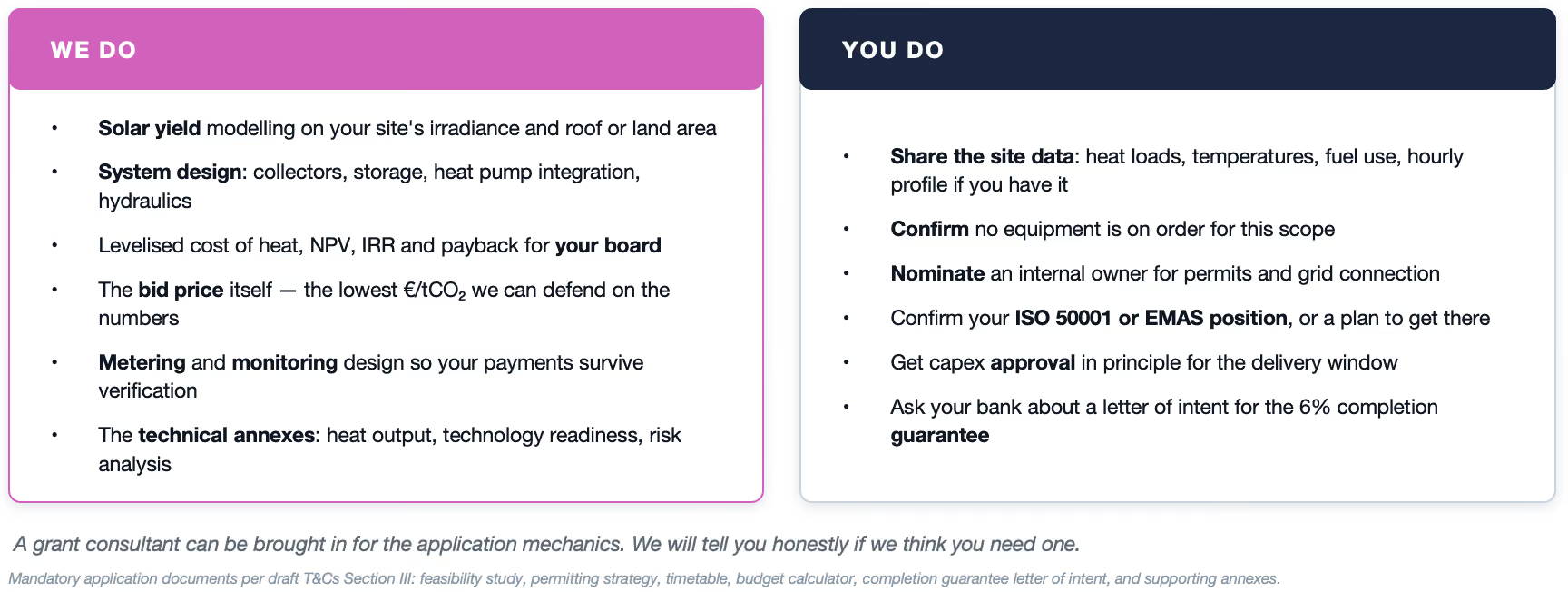
- Feasibility study. A completed study establishing the project's technical and financial viability is a core documentation requirement. Given that detailed design and engineering typically takes two to three months, this work needs to begin now for operators targeting the February 2027 deadline.
- Permitting strategy. Applicants must demonstrate a credible route to planning and permitting approval in their host country and at the relevant site level.
- Bank guarantee. A guarantee equivalent to 6% of the maximum grant requested is required as financial proof of applicant commitment. This should be budgeted as part of overall project financing.
- Bid structure. Bids must be submitted in €/tonne of CO2 abated, not €/MWh. Modelling should be built around this metric from the outset, including the quantified CO2 abatement the system delivers annually.
- System design for peak-hour performance. Technology choices that demonstrably reduce grid electricity demand during peak hours qualify for the bid bonus. Direct-renewable heat configurations should be specified and documented accordingly.
- Technology partner engagement. Having a partner with a track record in solar thermal system design, feasibility studies, and permitting documentation materially strengthens an application. The IF25 evidence is clear: preparation quality, not project scale, was the differentiating factor.
Naked Energy supports industrial applicants through the technical elements of IF26 preparation, including site assessment, solar thermal yield modelling, system design, and the technical documentation required for a complete and competitive application. Following a successful award, Naked Energy delivers full system design, installation, and ongoing operations and maintenance services. For details on our System Design solution, click here.
For sites where capital expenditure remains a constraint alongside or beyond the grant contribution, Naked Energy'sHeat-as-a-Service (HaaS) model allows the system to be financed and operated by a third party, with the customer paying only for the heat delivered. HaaS andIF26 grant funding can be structured together as part of a complete project financing approach. Find out more about our Heat-as-a-Service product, click here.
Conclusion
The IF26 Heat Auction is a well-funded and well-evidenced route to financing industrial heat decarbonisation across theEEA. The IF25 experience shows that prepared applicants face limited competition for substantial grant support. The direction of travel under ETS2 shows what the cost of delay looks like year by year. And the IF26 improvements, a lower temperature threshold, a bid bonus for direct-renewable heat, and a€/tonne CO2 abated bid structure, are designed with the technology realities of industrial solar heat clearly in mind.
For operators with process heat demand in the 80°C to 120°C range, the question is not whether solar thermal qualifies under IF26. It is whether preparation begins in time for the February 2027 deadline.
To discuss a feasibility study and IF26 application support, contact the Naked Energy team via the contact form or through your regional Business Development contact.
Note: Application opening dates and submission deadlines should be verified against the published IF26 call documents before making planning commitments. Draft terms were still in consultation at the time of writing.
Frequently Asked Questions
What is the IF26 Heat Auction?
The IF26 Heat Auction is a competitive EU grant scheme managed by the European Commission and financed through revenues from the EU Emissions Trading System. It offers up to €1 billion to fund industrial heat decarbonisation projects across EEA member states, with funding awarded on the basis of €/tonne of CO2 abated. It is the second iteration of the EUInnovation Fund's heat auction programme, following the IF25 pilot in 2025. Visit the ETS2 Explained blog for more details.
Who is eligible to apply for IF26 funding?
Industrial operators and manufacturers across EEA member states with projects that reduce CO2 emissions from process heat are eligible. Eligible technologies include direct-renewable heat (such as solar thermal) and electrification. For large projects above 10 MW, the minimum eligible delivery temperature is 80°C under the IF26 terms. This threshold is lower than the previous IF25 round, opening the scheme to a wider range of industrial processes including CIP, pasteurisation, and pre-heat applications.
How does the IF26 Heat Auction differ from IF25?
Three changes are most significant for solar thermal applicants. First, the minimum eligible temperature threshold for large projects has been lowered to 80°C, expanding the range of qualifying applications. Second, the bid mechanism has shifted from €/MWh to €/tonne ofCO2 abated, which rewards technologies with strong carbon displacement per unit of heat delivered. Third, a bid bonus has been introduced for technologies that reduce electricity grid demand during peak hours, a criterion that solar thermal meets by design.
Can solar thermal projects apply for IF26 funding?
Yes. Solar thermal is classified as a direct-renewable heat technology under the IF26 framework and is an eligible pathway alongside electrification. VirtuHOT and VirtuMAX evacuated tube collectors deliver process heat up to 120°C and cover the full IF26-eligible temperature range for industrial applications. Their generation of heat without electricity as an intermediate step also qualifies for the peak-hour bid bonus within the IF26 bid structure.
What documentation do applicants need to prepare?
Based on the draft IF26 Terms and Conditions, applicants are expected to provide a completed feasibility study, a permitting strategy for the project site, and a bank guarantee equal to 6% of the maximum grant requested. Bids must be submitted in €/tonne of CO2 abated. Given the short application window, feasibility work should begin well ahead of the expected December 2026 opening. All specific documentation requirements should be verified against the published call documents before submission.